This blog attempts to explain the link between meteor showers and comets. To begin let us have a look at these two objects individually.
1. Meteor showers: Meteor showers are visible at certain times of the year. These bright streaks of light appear to originate from a fixed direction in the sky. Individual meteor streaks are visible only for a few seconds. Debris from comets or asteroids, on entering the Earth’s atmosphere, heats up and disintegrates to produce the streaks. The individual object producing a meteor streak is called a meteoroid. The dimension of the meteoroid varies from the size of a grain of dust to that of an apple.
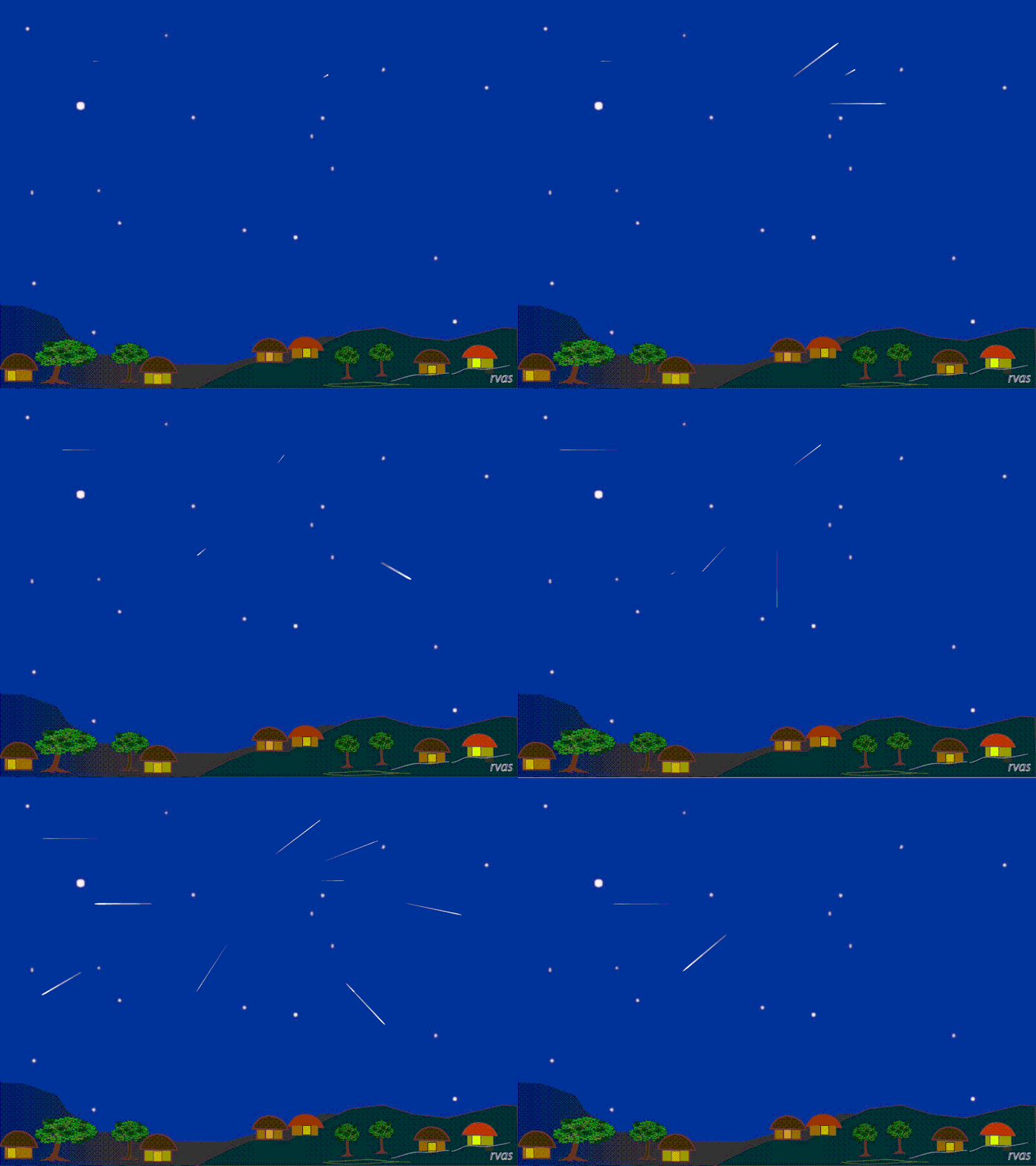
The following sections show how a comet evolves as it approaches the Sun and sheds the debris. A meteor shower occurs when the Earth crosses the path of the numerous meteoroids.
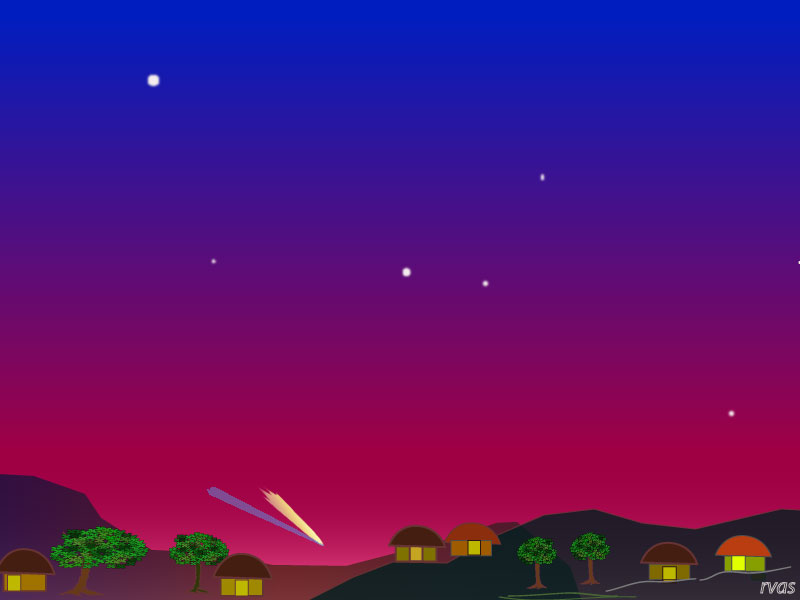
2. Comets and their origin: Comets are solar system objects gravitationally bound to the Sun. A comet remains visible for several days when it is near perihelion, its closest distance to the Sun. These are icy and rocky objects with sizes smaller than 10 km. Comets are primitive objects formed at the time of formation of the solar system from a collapsing interstellar cloud about 4.6 B years ago.
The central dense region of the collapsing and rotating interstellar cloud became the proto-Sun, containing 99.8% of the total mass. While the central material was collapsing and was passing through the proto-Sun phase, the rotating disc around the Sun cooled to condense as grains. Over a few million years, the dust grains coalesced into kilometer-sized bodies called the planetesimals. The planetesimals are the building blocks of the planets and their satellites. The planetesimals that failed to participate in planet formation continued to move around the Sun. These contribute to the population of the asteroids and comets. The path of the comets is elongated; hence, these objects spend most of their orbit in the cold outer regions. For this reason, comets, especially the long-period ones, remain mostly unaltered in composition and retain the primordial matter. Therefore, the study of comets is essential to understanding the initial conditions at the time of the solar system’s formation. The comets are a conglomeration of ice and dust. The ices are frozen water, Carbon monoxide, Carbon dioxide, Formaldehyde, Methanol, and other gases. The dust consists of silicates of Iron, Nickel, Aluminum, and other elements.
3. Formation of coma, dust & ion tails and meteoroids:
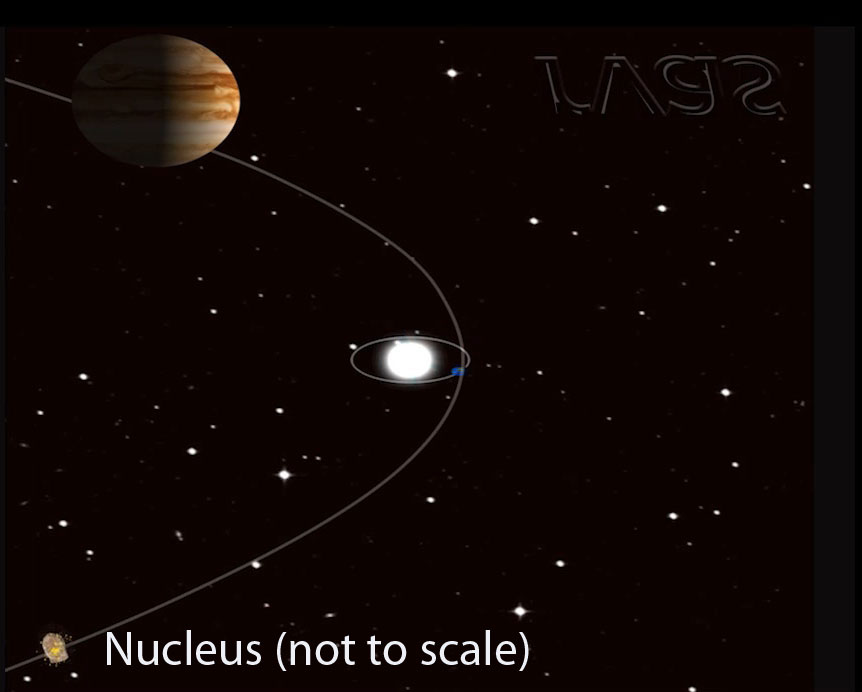
Comets orbit around the Sun in elliptical orbits. Let us observe what happens when a comet approaches the perihelion. As shown in the figure on the lower left, at far distances, the comet is a bare nucleus made of ice and rock. The planet at the top left is Jupiter. Only the Earth’s orbit is shown.
3.1 The coma: The cometary nucleus starts warming as it approaches the Sun. At the negligible pressure conditions in space, the ice sublime directly from solid to gaseous state. In the process, tiny dust grains are dragged by the expanding gases, forming an envelope called a coma around the nucleus. The sunlight illuminates the dust grains in the coma.
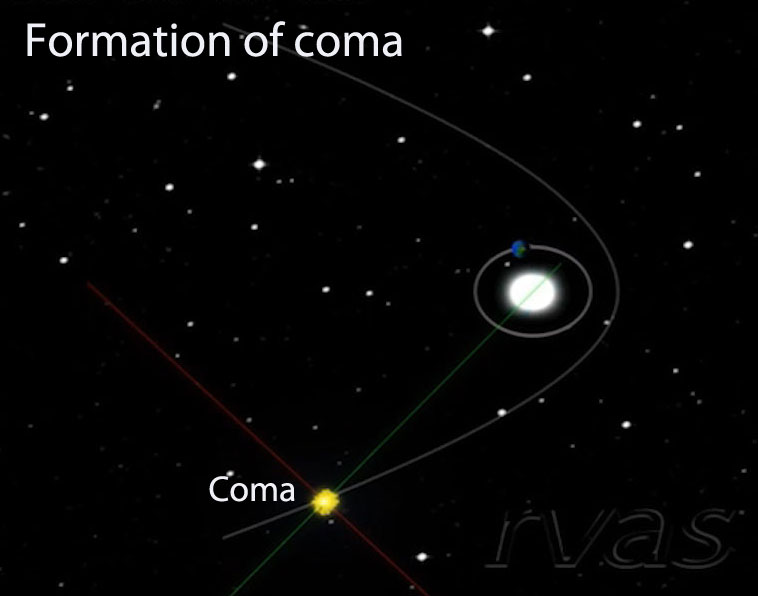
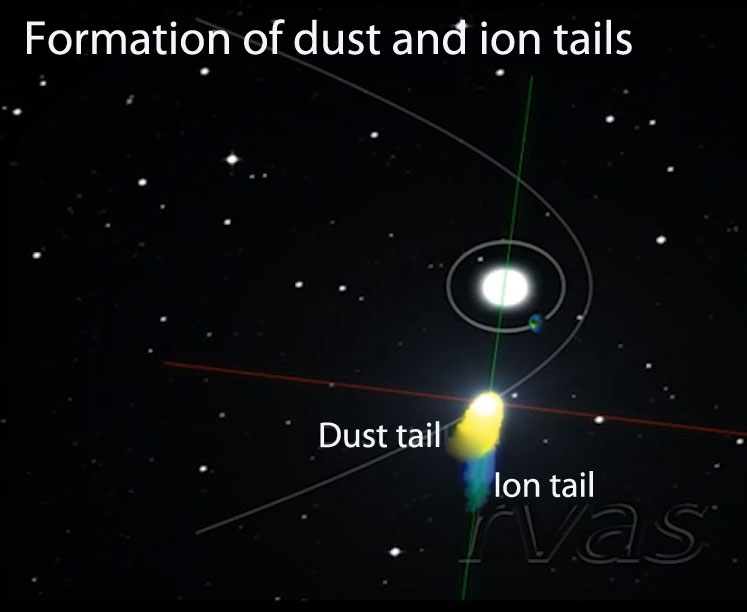
3.2 The dust tail: The grains will continue to move around the Sun even after separation from the comet according to Newton’s first law of motion. However, there is an additional force on the grains due to the solar radiation pressure. The radiation pressure is dependent on the size and optical properties of the grains. The dust grains from the coma are continuously pushed by radiation pressure to form a dust tail.
The orbital motion of the grains in the presence of radiation pressure makes the dust tail curve so that it lies between the comet’s orbit and the Sun-comet radius vector. As in the case of the coma, the dust tail is also illuminated by the sunlight.t.
3.3 The Ion tail: The molecules of the expanding gases from the nucleus get ionized by absorbing the solar ultraviolet radiation. These ions are swept away by the Solar wind (a stream of charged particles blown from the atmosphere of the Sun) as ion tail that points away from the Sun. The ion CO+ , a significant constituent of the ion tail, re-emits the absorbed sunlight at a wavelength of 0.42 microns by a process called fluorescence. This wavelength falls in the blue region of the electromagnetic spectrum; the ion tail is blue in color.
3.4 The Meteoroids: We saw that the solar radiation pressure depends on the size and nature of the grains. It is maximum for grains in the range of 0.2 to 0.4 microns and negligible for grains larger than 100 microns. These large grains continue to move in the comet’s path due to inertia. Thus, even after the comet has left the inner solar system, the associated meteoroids populate its path.
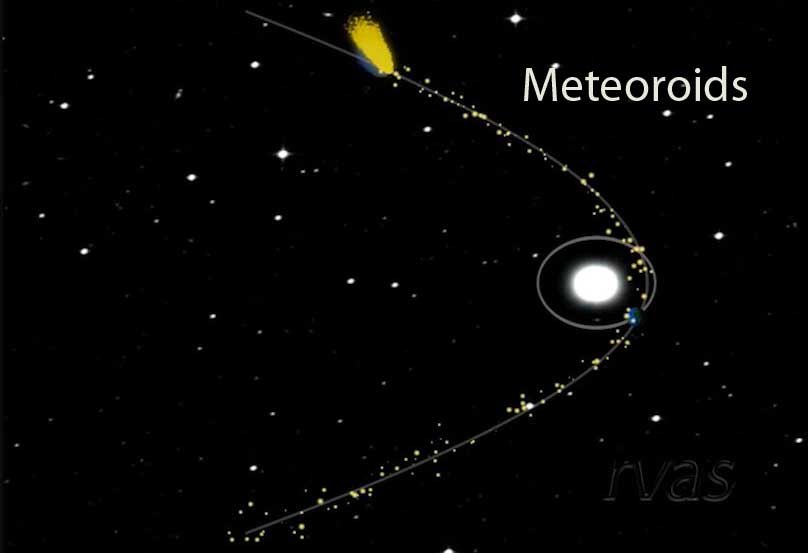
However, as these were ejected with finite velocity while being dragged by the gas, they are scattered along the comet’s path. Although negligible, radiation pressure force also scatters them from their initial orbit over time.

3.4.1 Encounter with the Earth: The meteoroids are confined to the plane of the comet’s orbit. The plane of the orbit is inclined to the plane of the Earth’s orbit. The inclination can range between -90 Deg. to +90 Deg.

The Earth’s orbital plane is called the ecliptic.

When the Earth crosses the line of intersection of these two planes, it encounters meteoroids. Since the Earth’s and comets’ orbits are fixed in space, the Earth’s passage through the meteoroid population will always occur around the exact date of the year and last for a few days. However, the peak date shifts over the years due to leap years.
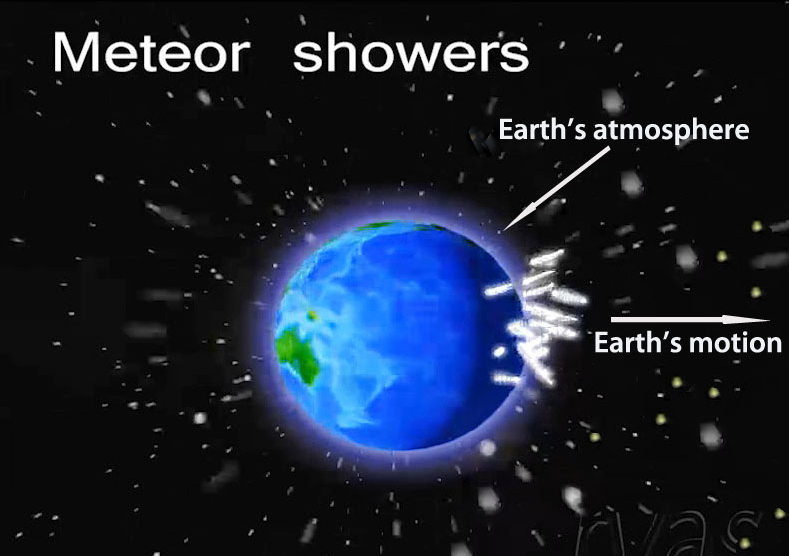
3.4.2 The meteor showers: During the encounter, the meteoroids enter the Earth’s atmosphere at 20 – 70 km/s. At this supersonic speed, the air in front of the meteoroid gets rapidly compressed.

The ram pressure heats the air and, consequently, the meteoroid to a few thousand degrees Kelvin. Under this immense heat, the meteoroid starts disintegrating into ionized atoms and electrons. The light of the meteor flash is mainly due to the emission of atomic lines and some molecular bands from this matter; the contribution of incandescent radiation is relatively small.
Atoms radiate at specific wavelengths. Magnesium emits in green, Calcium in red, and Iron has lines in the visible spectrum ranging from ultraviolet to red. As the disintegrated meteoroid traverses the atmosphere, it produces a streak of light. Meteor spectra provide information on the abundance of elements in comets’ non-volatile components (rocks). The disintegrated matter visible as a bright blob is called a meteor.
The radiant point is the direction from where the meteors appear to come. This direction depends on the Earth’s motion relative to the path of the meteor stream. Therefore, meteor showers are named after their corresponding radiant direction. For example, the Leonid meteor shower peaks around November 16-17, 2020; the radiant point is in the constellation Leo. The Debris is from comet 55P/Tempel-Tuttle. IMO’s website (International Meteor Organization) provides intensive meteor shower information.
eteoroids are also formed when asteroids crash together. The meteoroids that survive the harsh entry into the Earth’s atmosphere are called meteorites.
You Tube version of the post:
 rvas creations
Leave a comment